Check the Sampling Rate Before a Frequency Conversion Turns Aliasing Into a Confident Number
Convert hertz, kilohertz, megahertz, and gigahertz only after confirming the measured signal can be represented by the sampling rate.
Open Frequency Converter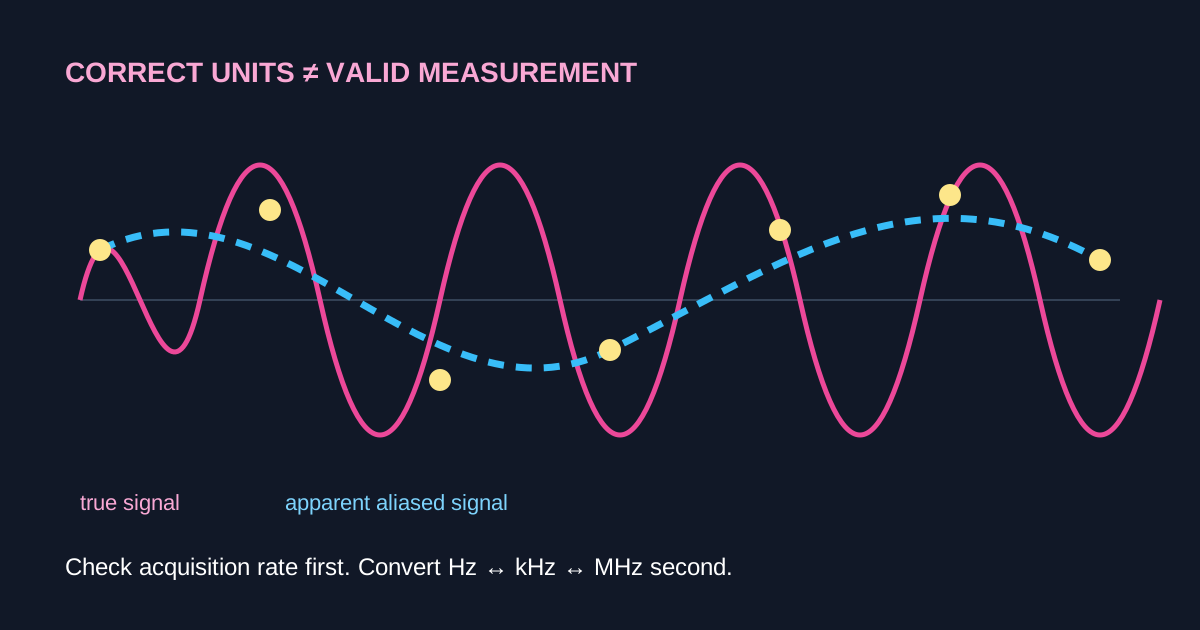
A log reports a 9 kHz oscillation from data sampled at 12 kHz. Converting 9 kHz to 9,000 Hz is arithmetically correct, but it does not rescue a measurement that may already be aliased.
Separate the unit calculation from measurement validity
Frequency conversion changes scale by powers of one thousand. Sampling asks a different question: whether observations were frequent enough to distinguish the original cycle. A basic sanity check requires the sample rate to exceed twice the highest frequency of interest, with practical systems leaving additional room for filtering.
A defensible conversion sequence
- Record the source value and unit exactly as reported.
- Confirm whether the value is a measured signal, configured clock, rotational rate, or labeled specification.
- For sampled measurements, compare the acquisition rate with the highest plausible input frequency.
- Use Frequency Converter to change Hz, kHz, MHz, or GHz only after that check.
- Carry uncertainty and the measurement method beside the converted value.
Related UtilFlow links
Use Frequency Converter for scale changes, Time Converter when period is reported in seconds or milliseconds, and Number Base Converter when a register or protocol exposes clock values in hexadecimal.
FAQ
How many hertz are in one kilohertz?
One kilohertz equals 1,000 hertz.
Does converting kHz to Hz fix an aliased measurement?
No. Unit conversion preserves the reported value; it cannot reconstruct a frequency that the sampling process misrepresented.
Why is twice the signal frequency a minimum?
It is the basic Nyquist boundary for ideal sampling; real acquisition usually needs margin and filtering.