Write the Crawl Policy Before a Robots.txt Rule Hides the Page You Meant to Index
Turn a crawl policy into narrow robots.txt rules, test path boundaries, and keep crawling controls separate from indexing and access control.
Open Robots.txt Generator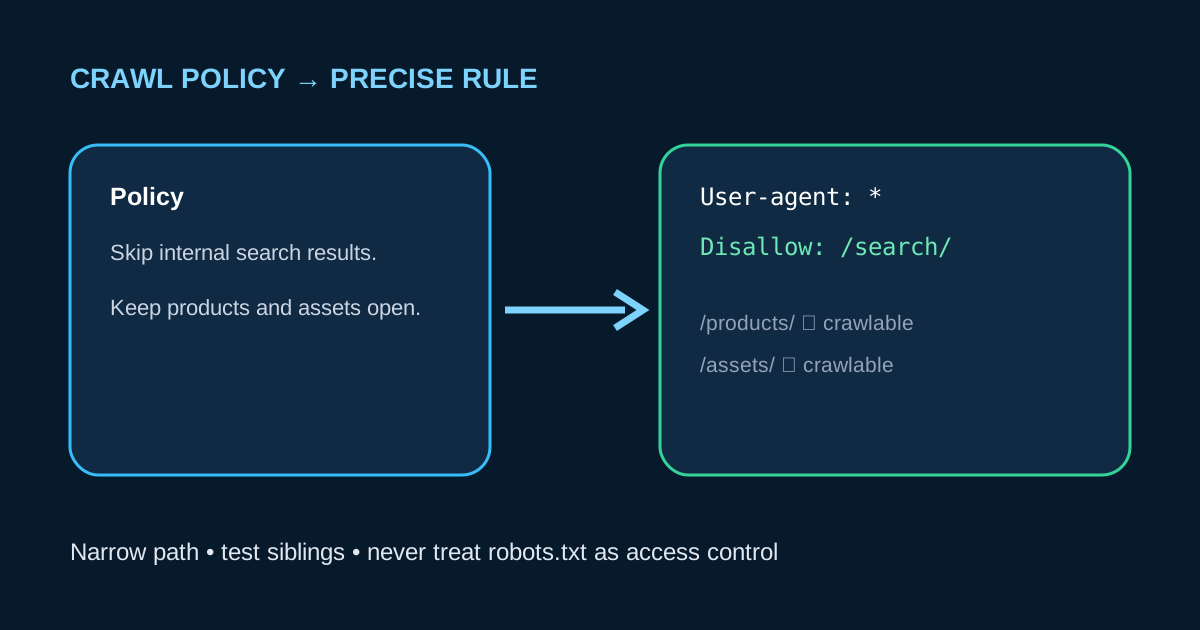
A team wants crawlers to skip an internal search-results area, but a rushed slash or wildcard can hide far more than intended. Start with the policy in plain language, then translate only that boundary into syntax.
Translate one policy statement at a time
- Name the crawler scope: every compliant crawler or one named user agent.
- Write the smallest path that represents the unwanted crawl space.
- Generate the robots.txt lines and read each Allow or Disallow back as a sentence.
- Test sibling paths that should remain crawlable, especially assets and public detail pages.
- Publish at the site root and keep the sitemap location explicit when one is available.
Robots.txt is not an access-control list
Robots.txt is a public instruction for compliant crawlers. It does not authenticate users, protect confidential URLs, or guarantee that a discovered URL disappears from search. Use application authorization for private content and page-level indexing controls when indexing is the real concern.
Related UtilFlow links
Use Robots.txt Generator for the crawl file, Sitemap Generator for the canonical public URL inventory, and Meta Tag Generator when a specific page needs its own search snippet and indexing directives.
FAQ
Can robots.txt keep a confidential page private?
No. Protect confidential content with authentication and authorization; robots.txt is publicly readable guidance for compliant crawlers.
Where should robots.txt be published?
Publish it at the origin root, such as example.com/robots.txt, so crawlers know where to request it.
Should I block every parameterized URL?
Only after confirming which parameters create unwanted crawl duplication and which still represent useful public pages.