Convert the Angle Unit Before the Trigonometry Result Looks Precise and Wrong
Understand degrees, radians, turns, and gradians as different scales for the same rotation, and keep unit assumptions visible in calculations.
Open Angle Converter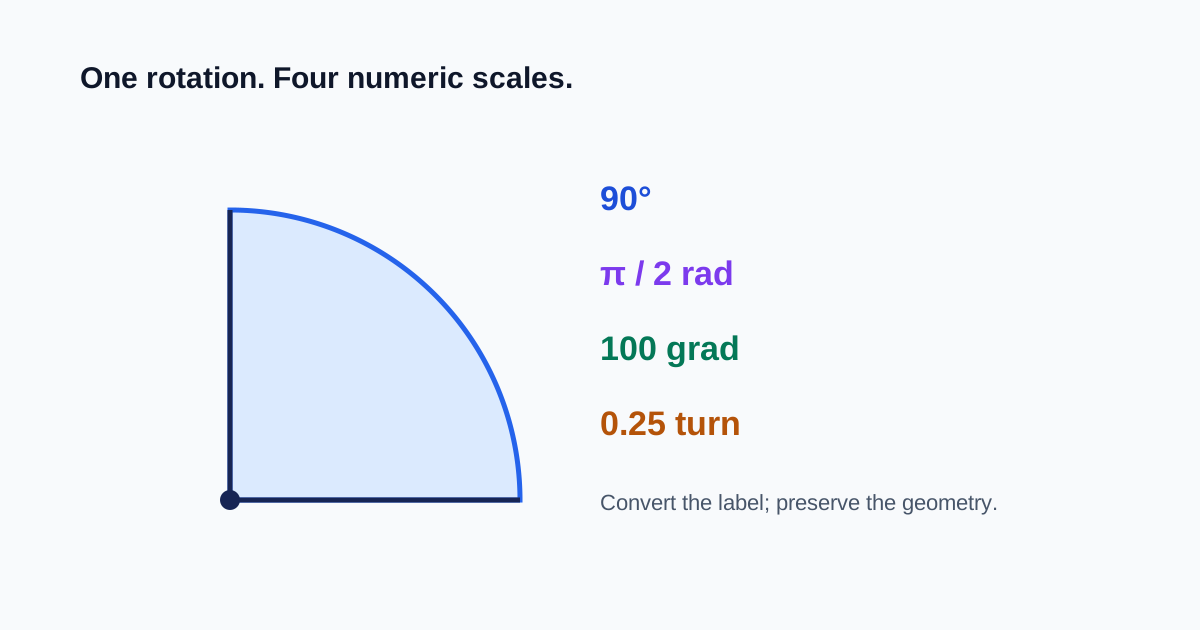
A rotation field says 90, a math function expects radians, and the output is numerically precise but visually absurd. Angle conversion errors survive review because every number is valid in some unit. The missing information is the scale.
All angle units describe a fraction of one turn
One full turn is 360 degrees, 2π radians, or 400 gradians. Conversion is a ratio against that full turn: radians = degrees × π / 180, and degrees = radians × 180 / π. Arcminutes and arcseconds divide a degree into 60 and 3,600 parts.
Preserve π until the final display
For exact symbolic work, keep 90° as π/2 instead of immediately rounding to 1.57. For device settings or CSS transforms, a decimal may be required. Convert once, carry enough precision internally, and round only at the destination's displayed precision.
A technical verification pattern
- Write the source unit beside the original value.
- Convert with the Angle Converter and copy both the value and target unit.
- Use a landmark check: 0, quarter turn, half turn, or full turn.
- Confirm whether the consuming API expects degrees or radians.
- Round for presentation after the calculation, not before it.
FAQ
How many radians are in 180 degrees?
Exactly π radians, approximately 3.14159265.
Why do programming math functions often use radians?
Radians express angles as arc length divided by radius and make many calculus relationships simpler, so they are the standard input for many math libraries.
When are gradians useful?
Gradians divide a right angle into 100 units and appear in some surveying and engineering contexts. Confirm the receiving convention before converting.