Parse Roman Numerals as Subtractive Pairs Before a Date or Outline Looks Valid and Isn't
Understand additive and subtractive Roman numeral rules, canonical forms, and the practical boundary between conversion and historical notation.
Open Roman Numeral Converter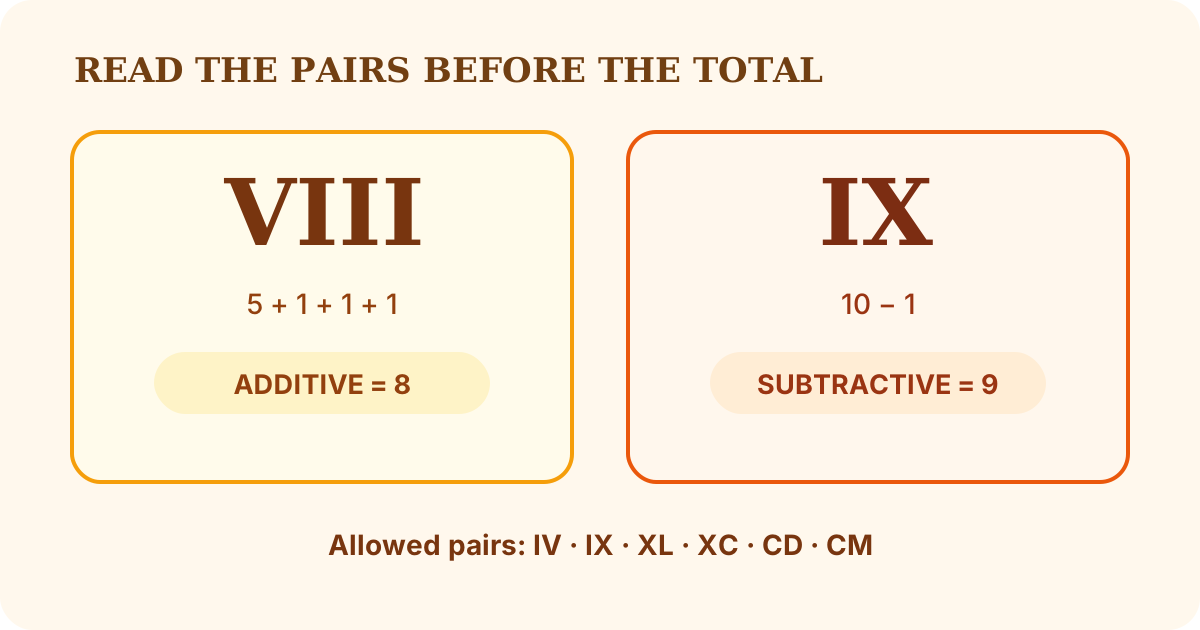
A chapter label reads IIX and is assumed to mean 8 because two ones appear before ten. A permissive calculation can reach that value, yet the conventional canonical form is VIII. Conversion is more reliable when it checks notation rules instead of treating every smaller-before-larger sequence as valid.
Roman notation combines addition with limited subtraction
Symbols normally descend and add: VIII is 5 + 1 + 1 + 1. Six conventional subtractive pairs handle values just below a larger symbol: IV, IX, XL, XC, CD, and CM. The smaller symbol is subtracted only in those established pairings.
A technical conversion checklist
- Normalize letter case before parsing.
- Scan left to right and recognize allowed subtractive pairs before adding single symbols.
- Check repetition rules: V, L, and D are not conventionally repeated; I, X, C, and M have limited repetition.
- Convert with Roman Numeral Converter and compare the canonical output when validating an existing label.
- Keep the original text when it is an inscription or stylistic historical form rather than modern canonical notation.
The common 1–3999 range is a product boundary
Many modern converters stop at 3999 because standard keyboard notation has no universally convenient way to express the overline convention for multiplying a symbol by one thousand. That boundary is an implementation choice for clear output, not the full history of Roman-number notation.
FAQ
What are the standard subtractive Roman numeral pairs?
They are IV, IX, XL, XC, CD, and CM.
Why is 8 written VIII instead of IIX?
Modern canonical notation builds 8 additively as 5 + 1 + 1 + 1. IIX is nonstandard even if a loose subtraction rule appears to produce 8.
Why do many converters stop at 3999?
Values above 3999 often need overlines or extended conventions that are awkward and inconsistent in plain text.