Square the Length Factor Before an Area Conversion Shrinks the Plan Twice
Understand why area conversion factors are squared, then verify floor plans, land measurements, and material estimates with dimensional reasoning.
Open Area Converter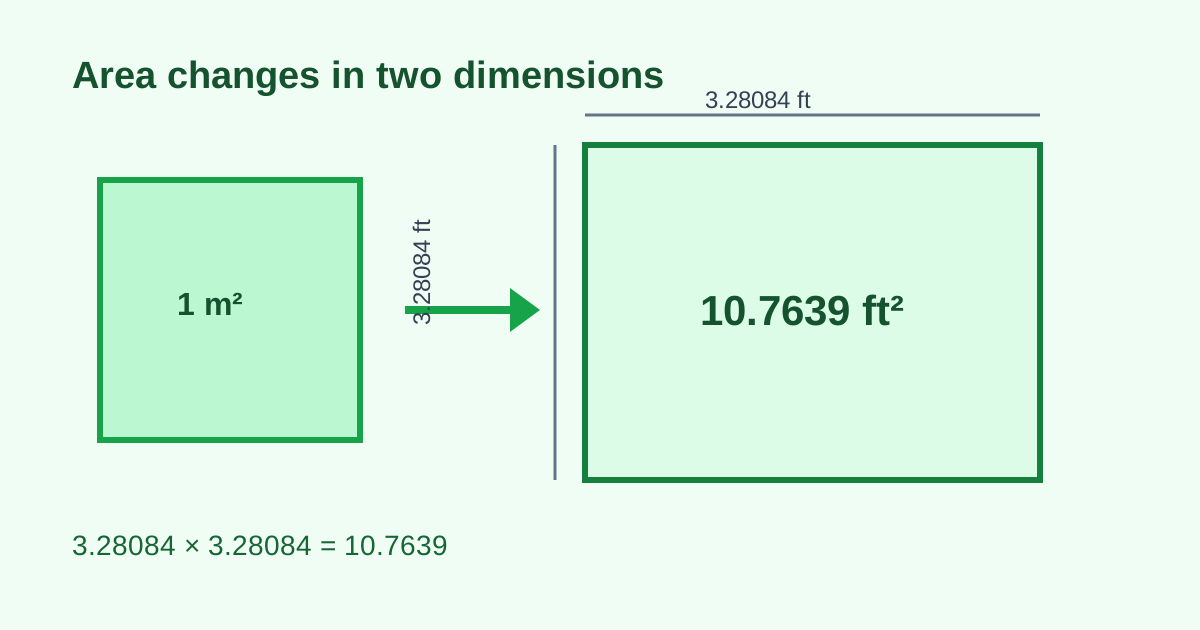
A plan labels a room in square meters, while a material quote uses square feet. Multiplying by the meters-to-feet length factor gives an answer that looks plausible but is far too small because area changes in two dimensions.
Area inherits the conversion factor twice
One meter equals about 3.28084 feet. A one-meter square is 3.28084 feet wide and 3.28084 feet long, so its area is 3.28084 squared, or about 10.7639 square feet. The unit name square feet is a reminder to square the length factor.
Use dimensions as a technical checksum
- Write the source value with the squared unit symbol.
- Convert it with Area Converter and retain enough precision for the estimate.
- Check the direction: one square meter must become more than one square foot.
- For rectangles, independently convert length and width, multiply them, and compare.
- Apply waste, coverage, or setback percentages after the unit conversion so the basis stays visible.
Land units are named areas, not lengths
Acres and hectares already describe area. Use their defined area factors directly rather than trying to infer a side length. If a parcel boundary is irregular, the source survey area is the quantity to convert; a bounding rectangle is not a substitute.
FAQ
How many square feet are in one square meter?
One square meter is approximately 10.7639 square feet.
Why can I not multiply area by 3.28084?
That factor converts one dimension from meters to feet. Area has two dimensions, so the factor must be squared.
Should material waste be added before or after conversion?
Either order is mathematically equivalent if precision is preserved, but converting first and showing waste as a separate step makes the estimate easier to audit.